
Generative AI for Software Architecture: From Requirements to Architecture to Code
1. Introduction: Why Software Architecture Needs AI Now
In the last decade, software architecture has evolved from simple, monolithic structures to sprawling ecosystems of microservices, cloud-native deployments, and AI-integrated components. Today’s systems are more distributed, complex, and fast-changing than ever before. A single project may involve dozens of APIs, multiple databases, and multi-cloud configurations — all while needing to remain scalable, secure, and maintainable.
For architects and senior developers, this complexity means more time spent on design documentation, dependency mapping, and requirement validation — tasks that can slow down delivery cycles and increase the risk of errors.
My Hosting Choice
Need Fast Hosting? I Use Hostinger Business
This site runs on the Business Hosting Plan. It handles high traffic, includes NVMe storage, and makes my pages load instantly.
Get Up to 75% Off Hostinger →⚡ 30-Day Money-Back Guarantee
Enter Generative AI for Software Architecture: a powerful shift where artificial intelligence doesn’t just help with writing code, but assists in shaping the entire architecture — from interpreting requirements to creating high-level designs, diagrams, and even generating deployment-ready code.
Instead of starting from a blank page, architects can now collaborate with AI to produce architecture blueprints, validate design decisions, and rapidly iterate on solutions. This isn’t about replacing human expertise — it’s about amplifying it with machine intelligence, enabling teams to move faster without sacrificing quality or scalability.
2. The Shift from Code Generation to Architecture Generation
When most developers think about AI in programming, they imagine tools that write functions, fix bugs, or suggest code snippets. That was the first wave of AI integration — highly useful, but limited to the implementation phase of software development.
The next wave is already here: AI for architecture generation. Instead of only writing code, modern AI systems can now take high-level requirements and translate them into complete system designs — identifying components, defining interactions, and producing diagrams that outline how the pieces fit together.
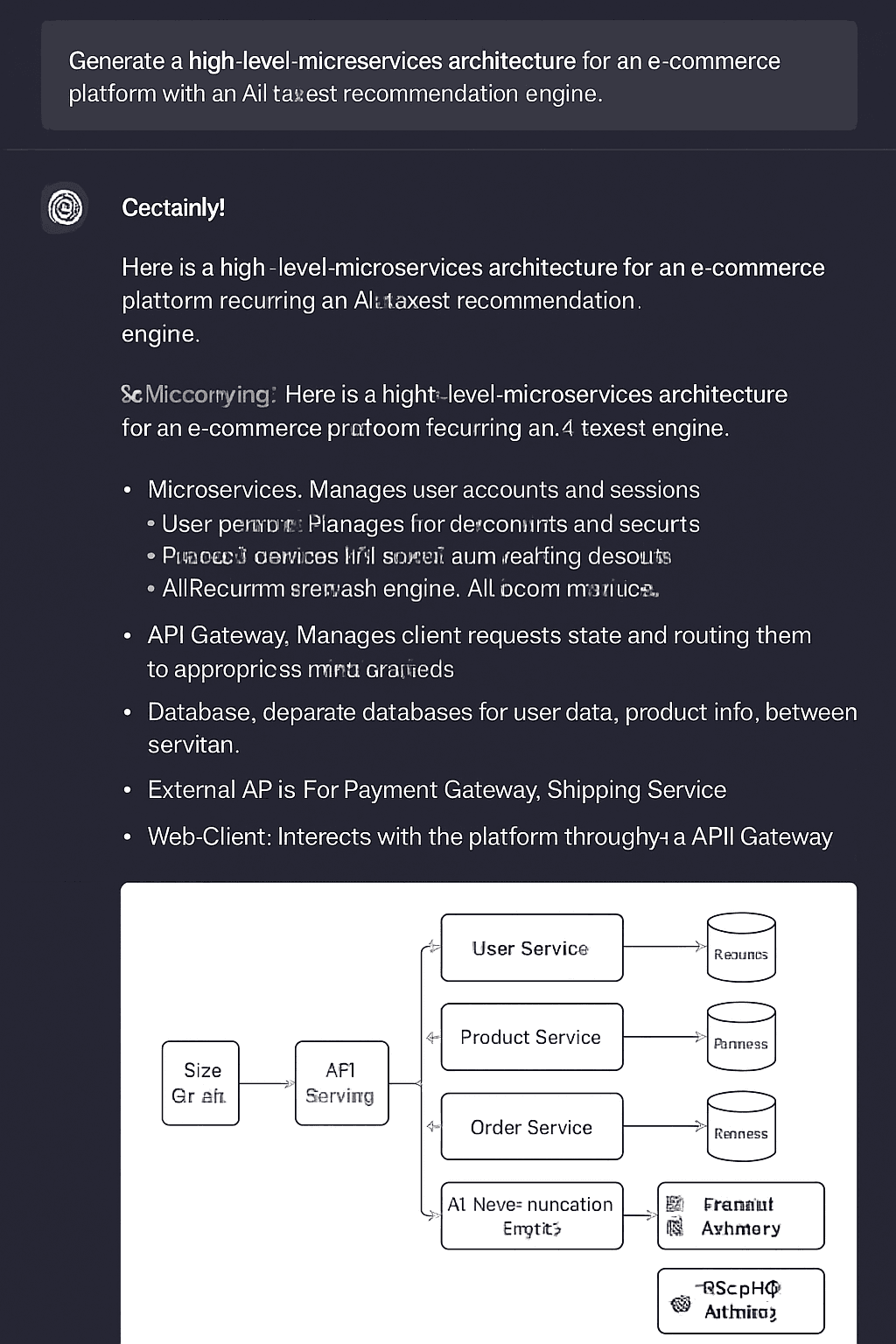
This is possible thanks to breakthroughs in multi-modal AI models, which can understand both natural language and structured representations like UML or C4 diagrams. In fact, research pilots by companies like Microsoft, OpenAI, and Anthropic have shown that AI can:
- Interpret user stories and functional requirements.
- Suggest optimal architectural patterns (e.g., event-driven, microservices, layered).
- Generate deployment diagrams optimized for scalability and cost.
- Highlight potential bottlenecks before coding begins.
Industry leaders are already experimenting with this. Several enterprise teams have integrated AI-powered architecture design into continuous integration pipelines, meaning architecture can evolve automatically as requirements change — without weeks of manual redesign.
3. How Generative AI Works in Architecture Design
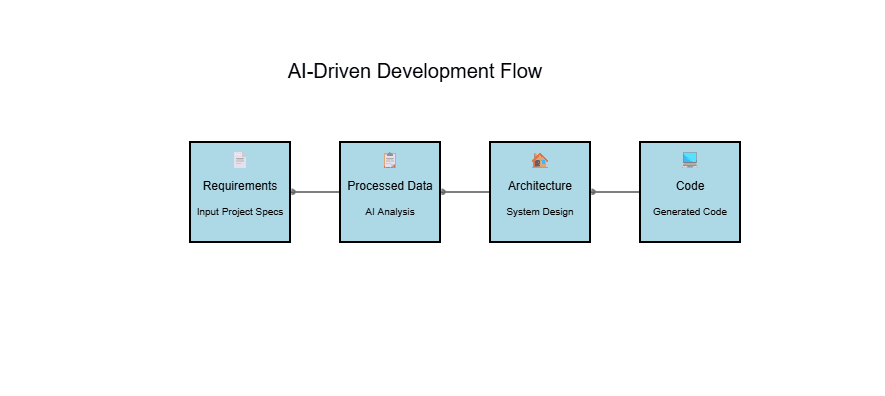
Generative AI in software architecture is more than a flashy diagram generator — it’s a structured process that bridges the gap between high-level requirements and production-ready code. Instead of manually translating business needs into technical blueprints, AI can follow a repeatable workflow that accelerates delivery and reduces design errors.
At a high level, the process works like this:
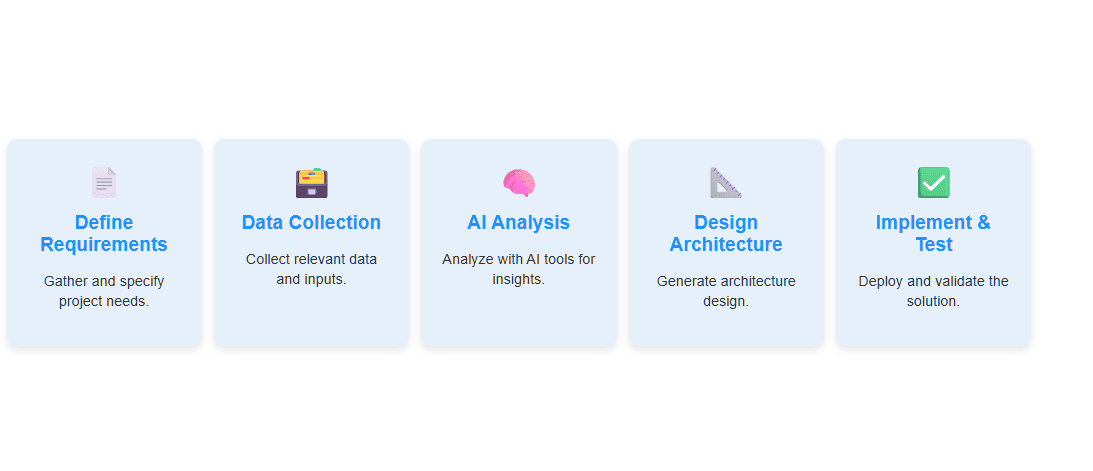
- Requirements Gathering – The AI starts with structured or unstructured input from stakeholders. This can be a project brief, user stories, or even a simple paragraph describing the desired application.
- Architectural Model Generation – Using trained patterns and reference architectures, the AI produces a high-level system design, including components, data flows, and integration points.
- Code Scaffolding – Once the architecture is finalized, the AI generates foundational code structures such as project boilerplates, service skeletons, and configuration files — ensuring development starts with a strong, consistent base.
Common Techniques Behind the Scenes
To achieve this end-to-end workflow, modern AI systems rely on a combination of specialized techniques:
- Few-Shot Prompting – Providing the AI with a small number of examples so it can infer the style, format, or structure of the desired output. This is particularly useful for generating architecture diagrams that match an organization’s standards.
- Retrieval-Augmented Generation (RAG) – Enabling the AI to query a knowledge base of architecture templates, case studies, and documentation before generating the design. This ensures outputs are grounded in proven best practices rather than purely “hallucinated” structures.
- Diagram-to-Code Transformations – Taking visual architectural representations (e.g., UML diagrams, C4 models) and converting them directly into code scaffolds. This shortens the gap between design and development, making the architecture immediately executable.
4. Benefits of AI-Driven Software Architecture
Integrating generative AI into the architecture design process isn’t just about novelty — it’s about unlocking speed, consistency, and scalability in how software systems are conceived and built. Whether for greenfield projects or legacy modernization, the advantages are already clear.
1. Faster Turnaround from Idea to Prototype
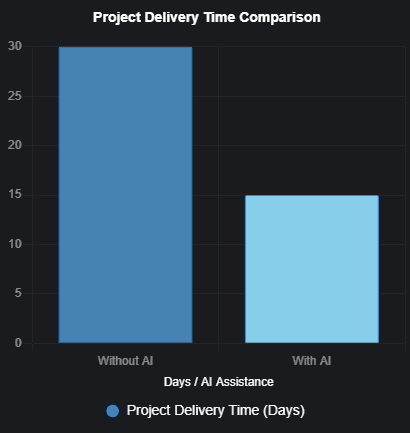
Traditionally, translating a concept into a working prototype could take weeks of stakeholder meetings, diagram drafting, and technical reviews. AI can compress that timeline to days — or even hours — by rapidly producing architecture diagrams and scaffolding code. This allows teams to iterate faster and bring ideas to market sooner.
2. More Consistent Adherence to Architectural Patterns
Architectural drift is a common problem in large teams, especially when multiple developers interpret requirements differently. AI can apply standardized architectural patterns automatically, ensuring that all generated designs conform to an organization’s best practices and governance rules. This improves maintainability and reduces the risk of technical debt.
3. Easier Refactoring for Legacy Systems
For legacy systems burdened with years of patchwork updates, AI can help reverse-engineer the existing architecture, identify inefficiencies, and propose optimized designs. From there, it can generate code scaffolding aligned with modern frameworks — making refactoring less painful and less risky.
5. Challenges and Limitations
While generative AI has made impressive strides in software architecture, it’s important to understand the current challenges and limitations that developers and teams face when adopting these tools:
1. Hallucinated or Unviable Designs
Generative AI models sometimes produce architecture diagrams or code scaffolding that look plausible but contain inaccuracies, contradictions, or unrealistic assumptions. These “hallucinations” can mislead developers, requiring careful review and validation before implementation. AI doesn’t yet fully understand real-world constraints or business context, so human oversight remains essential.
2. No Standard Evaluation Frameworks
Unlike traditional software architecture, where design patterns and best practices have mature evaluation criteria, AI-generated architectures currently lack standardized ways to assess quality, correctness, or feasibility. This absence makes it difficult to benchmark AI outputs or automate approval processes, slowing down adoption in enterprise environments.
3. Domain-Specific Knowledge Gaps
Most generative AI models are trained on broad datasets and may lack deep understanding of specific industry domains, legacy systems, or niche technologies. This can lead to designs that overlook critical domain constraints, compliance requirements, or integration challenges unique to certain sectors.
6. Tools & Platforms Leading the Way
Generative AI in software architecture is evolving rapidly, driven by innovative tools and research projects pushing the boundaries of what’s possible. Here are some of the leading players and platforms shaping this space today:
Useful Links
- The Era of Small Language Models (SLMs): Why 2026 Belongs to Edge AI
- Microsoft AutoGen vs. CrewAI: I Ran a “Code Battle” to See Who Wins in 2026
- How to Build AI Agents with LangChain and CrewAI (The Complete 2026 Guide)
- Beyond the Chatbot: Why 2026 is the Year of Agentic AI
- Why Developers Are Moving from ChatGPT to Local LLMs (2025)
- LangChain vs. LlamaIndex (2026): Which AI Framework Should You Choose?
ChatGPT + Diagram Plugins
OpenAI’s ChatGPT, combined with powerful diagram-generation plugins, enables developers to translate natural language requirements directly into visual architecture models. These plugins can create UML diagrams, flowcharts, and sequence diagrams on the fly, streamlining early design discussions and documentation.
GitHub Copilot Workspace (Future Vision)
GitHub Copilot is already a game-changer for code completion, but future iterations aim to extend its capabilities to full workspace-level architecture generation. Imagine a Copilot that not only writes code snippets but also suggests modular architectural layouts, component interactions, and system-level optimizations integrated into your IDE and CI/CD pipelines.
AI4Code Research Projects
Academic and industry research projects like AI4Code are exploring how advanced AI can generate end-to-end software architectures, including scalability patterns and deployment topologies. These experimental platforms test new algorithms for combining requirement analysis, architecture design, and automated code scaffolding.
Integration into CI/CD Pipelines
Modern DevOps workflows increasingly incorporate AI-driven architecture tools as part of continuous integration and continuous deployment (CI/CD) processes. Automated generation and validation of architecture diagrams and scaffolded code can be integrated into build pipelines to catch design issues early, enforce architectural standards, and accelerate delivery cycles.
7. Developer’s Guide: Using AI for Architecture Today
Ready to leverage generative AI in your software architecture workflow? Here’s a practical step-by-step guide to help you get started and maximize the benefits while minimizing common pitfalls:
1. Define Requirements Clearly
Start with a detailed and unambiguous set of requirements. The more precise your input, the better the AI’s output will be. Break down functional and non-functional needs, user roles, data flows, and any constraints that impact the system design.
2. Use AI Prompts with Constraints
When interacting with AI tools, craft prompts that include specific constraints or architectural patterns you want to follow. For example, specify “microservices architecture” or “event-driven design” to guide the AI toward viable solutions rather than generic outputs.
3. Export or Refine Diagrams
Once the AI generates architecture diagrams, export them to your preferred design tool (like Lucidchart or Draw.io) for refinement. Collaborate with your team to adjust the diagrams, ensuring they align with real-world constraints and business goals.
4. Translate Into Code with Scaffold Generators
Use scaffold generators or AI-powered code assistants to convert refined architectural designs into boilerplate code. This accelerates development by creating consistent project structures, configuration files, and interface contracts.
5. Review and Adjust Manually
AI-generated architecture is rarely perfect on the first try. Conduct thorough code reviews and architectural validation sessions to identify gaps, improve performance, and ensure compliance with security and operational standards. Your expert input remains indispensable.
8. The Future: AI Architects in the Development Lifecycle
As generative AI continues to advance, the role of AI in software architecture is poised for transformative evolution. Here’s what the future holds for AI architects and their integration within the software development lifecycle:
Predictions for Role Evolution
AI is expected to move beyond assisting with isolated tasks toward becoming a collaborative “virtual architect” — proactively suggesting system improvements, detecting architectural anti-patterns, and dynamically adapting designs based on real-time feedback and changing requirements. This evolution could dramatically reduce time-to-market and improve system resilience.
Ethical and Regulatory Considerations
With AI playing a more critical role in architecture design, ethical challenges around accountability, transparency, and bias will come to the forefront. Regulatory frameworks may emerge requiring AI-generated designs to meet standards for security, privacy, and fairness, especially in sensitive industries like healthcare, finance, and government.
Integration with Other AI Agents
The future development environment will likely feature ecosystems of specialized AI agents working in concert — from requirement analyzers to code optimizers to deployment strategists. These interconnected AI systems will enable seamless end-to-end automation, turning high-level ideas into robust, maintainable software solutions with minimal human intervention.

9. Conclusion
Generative AI is rapidly reshaping the landscape of software architecture — from translating requirements into system designs to scaffolding production-ready code. The potential to accelerate development cycles, enhance consistency, and improve adaptability is immense. However, challenges like AI hallucinations, evaluation gaps, and domain-specific limitations remind us that human expertise remains essential.
The future belongs to those who embrace these AI tools thoughtfully, combining them with their own knowledge and creativity. Experiment with generative AI in your architecture workflows, adapt your processes, and stay ahead of the curve to build smarter, faster, and more reliable software systems.
Q1: Can AI completely replace software architects?
A: No — AI can accelerate design and automate repetitive tasks, but human architects are still crucial for context, domain expertise, and ethical decision-making.
Q2: Which AI models are best for architecture design?
A: GPT-4, Claude 3.5, and Llama 3 paired with diagram-generation tools work well in early-stage experiments.
Q3: Is AI-generated architecture production-ready?
A: Often it’s a solid starting point, but most outputs require review, validation, and modification by experienced developers.
Q4: How do I secure AI-generated designs?
A: Use private LLM instances when dealing with sensitive data, and always review generated designs for compliance and security gaps.
Q5: Does this trend have long-term potential?
A: Yes — as models improve, AI-assisted architecture will likely become a standard step in software development workflows.
🚀 Let's Build Something Amazing Together
Hi, I'm Abdul Rehman Khan, founder of Dev Tech Insights & Dark Tech Insights. I specialize in turning ideas into fast, scalable, and modern web solutions. From startups to enterprises, I've helped teams launch products that grow.
- ⚡ Frontend Development (HTML, CSS, JavaScript)
- 📱 MVP Development (from idea to launch)
- 📱 Mobile & Web Apps (React, Next.js, Node.js)
- 📊 Streamlit Dashboards & AI Tools
- 🔍 SEO & Web Performance Optimization
- 🛠️ Custom WordPress & Plugin Development