

The Evolution of JavaScript Frameworks: What’s Next for Frontend Development?

Introduction:
JavaScript frameworks have revolutionized frontend development over the past decade, simplifying complex tasks and making it easier to build dynamic, interactive web applications. From the early days of jQuery to the modern frameworks like React, Angular, and Vue.js, the JavaScript ecosystem has evolved rapidly. As we move into 2025, the question remains: What’s next for frontend development?
In this blog post, we’ll take a look at the history of JavaScript frameworks, explore the current landscape, and discuss the exciting possibilities for the future.
My Hosting Choice
Need Fast Hosting? I Use Hostinger Business
This site runs on the Business Hosting Plan. It handles high traffic, includes NVMe storage, and makes my pages load instantly.
Get Up to 75% Off Hostinger →⚡ 30-Day Money-Back Guarantee
The Rise of JavaScript Frameworks
In the early days of web development, JavaScript was primarily used for basic tasks like form validation and interactive elements. However, as websites became more dynamic and user-centric, developers needed more robust solutions for building interactive user interfaces. This is where JavaScript frameworks came in.
1. jQuery: The Pioneer
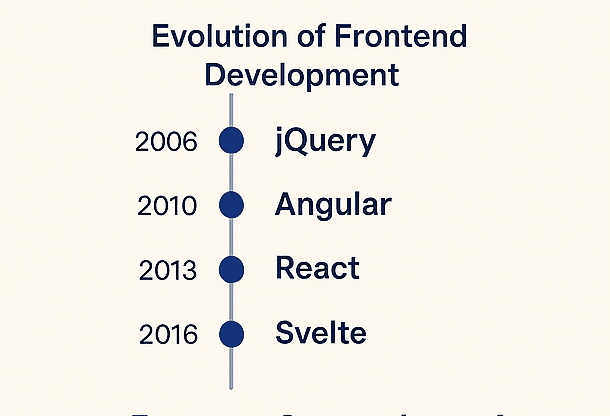
Launched in 2006, jQuery was the first popular JavaScript library to simplify DOM manipulation and event handling. It enabled developers to write less code, making JavaScript more accessible.
2. Angular: The First Major Framework
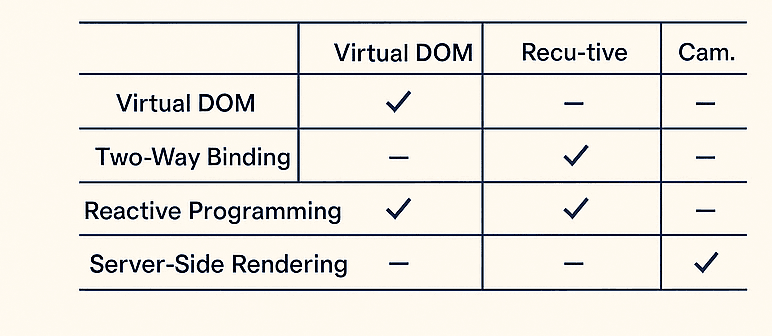
In 2010, AngularJS (now Angular) was introduced by Google. It was a game-changer in the frontend ecosystem by providing two-way data binding and a declarative approach to building user interfaces. Angular became the go-to framework for building large-scale applications.
3. React: The Virtual DOM Revolution
Released by Facebook in 2013, React introduced the concept of the Virtual DOM, significantly improving performance. Its component-based architecture quickly gained traction, making it the most popular framework for building dynamic and reusable UI components.
4. Vue.js: Simplicity Meets Power
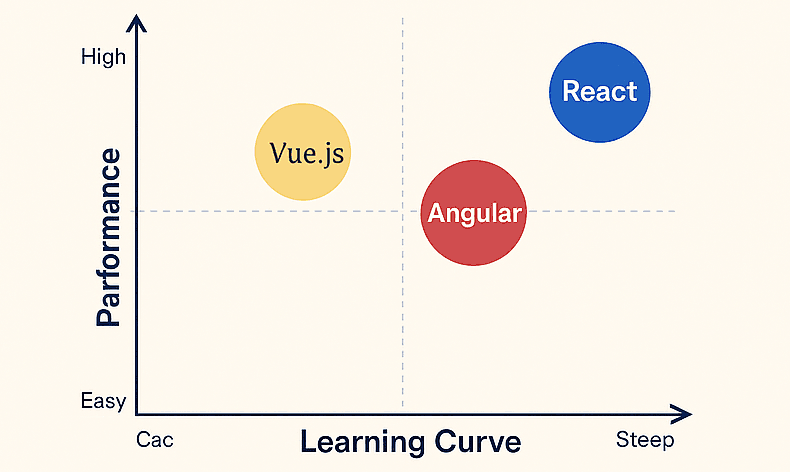
Vue.js, created by Evan You in 2014, provided a simpler, more flexible alternative to Angular and React. Vue’s gentle learning curve and flexibility made it a favorite among developers who wanted a progressive framework.
Current Landscape: Frameworks in 2025
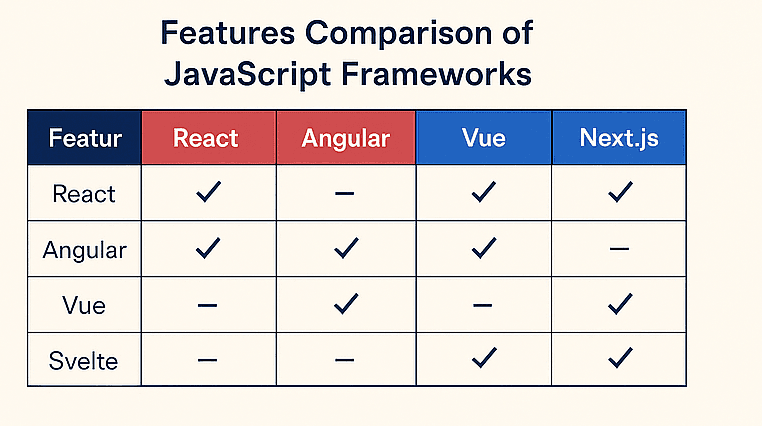
As of 2025, React, Angular, and Vue.js dominate the frontend landscape, but the ecosystem continues to evolve with new contenders emerging.
1. Svelte: The Compiled Framework
Svelte has emerged as a compelling alternative to React, Angular, and Vue by offering a highly optimized, compiler-based approach to building web applications. Svelte shifts much of the work from the browser to the build step, resulting in faster performance and smaller bundles.
2. Next.js: The React Framework for Server-Side Rendering
Next.js builds on React’s strengths, enabling server-side rendering (SSR) and static site generation (SSG) out-of-the-box. It has become the go-to framework for React developers looking to build SEO-friendly, fast-loading websites.
3. Remix: Full-stack React
Remix is an exciting new framework built on top of React that emphasizes fast navigation, load times, and server-side rendering. It’s designed to work seamlessly with React while simplifying routing and server rendering.
What’s Next for Frontend Development?
The next wave of frontend development will likely be influenced by trends such as serverless architecture, edge computing, WebAssembly, and AI-powered frameworks.
1. Serverless & Edge Computing
Frontend frameworks will increasingly integrate with serverless architectures, where backend services are handled by third-party providers like AWS Lambda or Vercel. Edge computing, where data is processed closer to the user’s location, will enable faster response times for global users.
2. WebAssembly: The Future of Performance
WebAssembly (Wasm) is poised to enhance frontend development by allowing languages like C, C++, and Rust to run in the browser. This will open the door for performance-critical applications such as gaming, 3D graphics, and video editing.
3. AI-Powered Development
Artificial Intelligence will play a role in automating repetitive tasks in frontend development. Imagine tools that can automatically optimize code, detect bugs, and even suggest improvements, all based on AI-driven insights.
Useful Links
- Forget Selenium: Building AI Agents with browser-use & DeepSeek (The New 2026 Standard)
- The End of Localhost? Why Cloud Dev Environments (CDEs) Are Taking Over
- Cybersecurity for AI Workloads: Protecting ML Pipelines in 2025 and Beyond
- AI-Native Grads vs. Traditional Developers: The Talent War CEOs Are Betting On
- Google’s New Ranking Factor Is Quietly Killing Small Developer Blogs (2025 Guide)
- 📛 What Developers Should Stop Doing in 2025 (And What to Do Instead)
FAQs
Q1. What are the main differences between React, Angular, and Vue.js?
React: A library for building user interfaces, focusing on reusable components and Virtual DOM for optimal performance.
Angular: A full-fledged framework providing two-way data binding, dependency injection, and a more opinionated structure for large-scale applications.
Vue.js: A progressive framework with a gentle learning curve that combines features from React and Angular.
Q2. Is Svelte better than React?
Svelte offers better performance by compiling components into efficient vanilla JavaScript during build time. Unlike React, which requires a virtual DOM, Svelte directly manipulates the DOM, leading to faster updates and smaller bundle sizes. While React is more popular and has a larger ecosystem, Svelte is a compelling choice for performance-sensitive projects.
Q3. How do I choose the right framework for my project?
Choosing a framework depends on factors like project size, team expertise, performance requirements, and long-term maintenance. React is a safe bet for large projects and has a huge ecosystem. Angular works well for enterprise applications, while Vue is ideal for smaller to mid-sized projects that need flexibility.
Useful Links

🚀 Let's Build Something Amazing Together
Hi, I'm Abdul Rehman Khan, founder of Dev Tech Insights & Dark Tech Insights. I specialize in turning ideas into fast, scalable, and modern web solutions. From startups to enterprises, I've helped teams launch products that grow.
- ⚡ Frontend Development (HTML, CSS, JavaScript)
- 📱 MVP Development (from idea to launch)
- 📱 Mobile & Web Apps (React, Next.js, Node.js)
- 📊 Streamlit Dashboards & AI Tools
- 🔍 SEO & Web Performance Optimization
- 🛠️ Custom WordPress & Plugin Development

Abdul Rehman Khan
Articles: 1615 Comments
Leave a Reply
You must be logged in to post a comment.






[…] The Evolution of JavaScript Frameworks: What’s Next for Frontend Development? […]
[…] The Evolution of JavaScript Frameworks: What’s Next for Frontend Development? […]
It’s really a great and useful piece of information.
I’m happy that you sjmply shared this helpful info with us.
Please sgay us informed like this. Thank you for sharing. http://Boyarka-Inform.com/
https://speakerdeck.com/roscarpt
Hey there!
Welcome to Moviezhive.com, where blockbuster entertainment is just a click away!
Stream a vast collection of Bollywood, Hollywood, and international movies for free—no subscriptions, no hassles.
What Makes Us Special?
✔️ Thousands of movies across all genres
✔️ Zero pop-up ads for seamless viewing
✔️ Advanced zero-buffering tech for smooth playback
✔️ Fresh titles added regularly
Can’t find a movie? Request it, and we’ll upload it fast!
Watch anytime, anywhere. Visit https://moviezhive.com now and start your movie adventure!
Enjoy the Show,
The Moviezhive Team