

Rust in 2025: Why Developers Are Choosing It for Web and System Development

Table of Contents
Introduction – The Rise of Rust in 2025
Over the last decade, the programming world has been flooded with new languages, frameworks, and tools, each promising to make development faster, safer, or more scalable. Yet, very few have managed to disrupt the industry as much as Rust. Originally launched in 2010 as a systems programming language with safety guarantees, Rust has steadily evolved into a developer favorite. By 2025, it has not only maintained its title as the “most admired programming language” for nine consecutive years (according to the Stack Overflow Developer Survey) but has also emerged as a practical choice for web development, blockchain infrastructure, and high-performance system software.
The growth of Rust in 2025 is not just about hype—it’s about adoption. Tech giants like Microsoft, Amazon, Cloudflare, and Mozilla have integrated Rust into their core infrastructure, citing its unmatched memory safety and concurrency handling. On the other side, startups and independent developers are choosing Rust for cutting-edge use cases like WebAssembly apps, AI agents, and decentralized applications (dApps). This dual adoption—by both enterprises and innovators—signals that Rust has moved from being “experimental” to mainstream critical technology.
My Hosting Choice
Need Fast Hosting? I Use Hostinger Business
This site runs on the Business Hosting Plan. It handles high traffic, includes NVMe storage, and makes my pages load instantly.
Get Up to 75% Off Hostinger →⚡ 30-Day Money-Back Guarantee
So, what makes Rust so attractive in 2025 compared to languages like C++, Go, or even Python? The answer lies in its combination of low-level control, high-level expressiveness, and a strong developer ecosystem. Unlike traditional system languages that trade safety for speed, Rust delivers both. Unlike high-level languages that sacrifice performance for ease of use, Rust strikes a near-perfect balance. In this blog, we’ll dive deep into the reasons behind Rust’s meteoric rise, explore its role in web and system development, and understand why every developer should at least consider learning Rust in 2025.

What Makes Rust Special in 2025
Rust’s rise to prominence is no accident—it is the result of solving some of the hardest problems in software engineering while keeping developers productive. At its core, Rust is designed to eliminate the dreaded memory safety issues that plague languages like C and C++. Buffer overflows, dangling pointers, and race conditions are all but impossible in Rust thanks to its ownership model and borrow checker. While this can feel strict to beginners, developers quickly realize it prevents entire classes of bugs before the code even compiles. In 2025, this reliability has become a crucial differentiator for companies building software where security, uptime, and performance are non-negotiable.
Another reason Rust shines in 2025 is its balance between low-level control and high-level ergonomics. Developers who are used to writing in Python or JavaScript appreciate Rust’s expressive syntax, powerful macros, and modern tooling, while system programmers benefit from precise control over memory and threads. The result is a language that feels both powerful and accessible, especially with the rise of educational resources, official documentation improvements, and community-driven crates (Rust’s package ecosystem). By 2025, Rust’s ecosystem has matured enough to rival older languages, making it a realistic option for both large-scale enterprises and individual developers.
Rust’s performance cannot be overstated. Benchmarks consistently show Rust matching or surpassing C and C++ in execution speed, while still offering concurrency support that avoids common pitfalls. This is particularly valuable in areas like web servers, distributed systems, blockchain infrastructure, and real-time applications, where concurrency and memory safety are critical. Moreover, the rise of WebAssembly (Wasm) has opened new doors for Rust developers—allowing them to build apps that run natively in browsers with near-C performance. Combined with Rust’s role in secure environments like embedded devices and cloud infrastructure, it has transformed from a niche systems tool to a universal programming language for the future.

Rust in Web Development – From WebAssembly to Frameworks
When people first think of Rust, they often imagine it as a low-level systems language competing with C++. But in 2025, Rust has become a serious player in web development—thanks largely to its integration with WebAssembly (Wasm) and a growing ecosystem of frameworks. WebAssembly allows code written in languages like Rust to run directly inside browsers at near-native speed. This means developers can build highly interactive, performance-sensitive web apps—such as 3D visualizations, AI-powered tools, and real-time gaming experiences—that were once impossible with JavaScript alone. For many developers, Rust + Wasm has become the go-to stack for fast, secure, and resource-efficient web applications.
Frameworks have also pushed Rust further into mainstream web development. Tools like Rocket and Actix Web are enabling developers to build full-featured web backends with Rust, combining safety and concurrency with modern APIs. In benchmarks, Actix Web has consistently ranked among the fastest web frameworks in the world, proving that Rust is not just safe but also capable of handling massive workloads. Startups and enterprises alike are adopting Rust frameworks for APIs, microservices, and serverless environments—especially when performance is critical. With the expansion of serverless platforms supporting Wasm runtimes (like Cloudflare Workers and Fastly Compute@Edge), Rust developers can now deploy highly optimized server-side logic without managing infrastructure.
For frontend developers, Rust offers an exciting opportunity to bridge the gap between JavaScript ecosystems and high-performance computing. Frameworks like Yew allow developers to write frontend applications in Rust, compiling down to Wasm for blazing-fast execution in the browser. While not a replacement for React or Vue, Yew and similar projects show what the future of frontend engineering might look like—where performance-heavy tasks can shift from JavaScript to Rust without sacrificing developer experience. By 2025, this combination of framework maturity, Wasm adoption, and developer enthusiasm has positioned Rust as a unique language that serves both backend and frontend needs in modern web development.

Rust in System Programming and Blockchain
Rust’s original purpose was to be a systems programming language, and in 2025, that foundation continues to drive its success in some of the most demanding industries. Traditional system programming languages like C and C++ are known for speed and control but come with serious drawbacks—particularly around memory management and concurrency. Rust solves these problems with its ownership model, ensuring safety without sacrificing performance. This has made Rust the preferred choice for building operating system kernels, device drivers, compilers, and embedded software. Projects like Redox OS (an operating system entirely written in Rust) demonstrate the language’s potential to underpin large-scale, low-level systems while remaining modern and secure.
Beyond traditional systems, Rust has also carved out a significant place in the blockchain and Web3 ecosystem. Security and performance are paramount in blockchain environments, where vulnerabilities can cost millions of dollars and performance bottlenecks can undermine entire networks. In 2025, many blockchain projects—including Polkadot, Solana, and Near Protocol—are heavily reliant on Rust. Its guarantees against memory leaks and data races make it ideal for decentralized systems where reliability is non-negotiable. Developers in the blockchain space also praise Rust’s ecosystem of cryptographic libraries and concurrency tools, which simplify building high-performance, scalable smart contracts and consensus mechanisms.
The convergence of system-level reliability and blockchain innovation has made Rust a unique player in both domains. While Go and C++ still have strong presences, Rust’s adoption is accelerating because it reduces technical debt and offers future-proof security in industries where failure is not an option. Whether it’s running critical infrastructure for cloud providers like AWS and Microsoft Azure or securing decentralized apps on cutting-edge blockchains, Rust is proving that it isn’t just another language—it’s a cornerstone of the modern computing landscape. In 2025, developers entering systems programming or blockchain development are increasingly expected to have Rust in their toolkit.
The Future of Rust in 2025 and Beyond
Rust’s journey from a niche systems programming language to a mainstream choice for modern development has been nothing short of impressive. By 2025, its adoption has moved beyond enthusiasts and open-source contributors into enterprise ecosystems. Big players like Microsoft, Google, and AWS are not only contributing to Rust but actively integrating it into their products. For example, Rust is being used to build safer components in operating systems, web browsers, and even in cloud-native applications, reducing vulnerabilities that would otherwise be common in languages like C or C++.
Useful Links
- Forget Selenium: Building AI Agents with browser-use & DeepSeek (The New 2026 Standard)
- Why Developer Communities Are the New Universities in 2025
- Top Low-Code & No-Code Development Platforms for Dev Teams in 2025
- Is Bun Ready to Replace Node.js in Production? A 2025 Developer’s Take
- 10 High-Paying Developer Skills to Learn in 2025 for Career Growth
- The Hidden Risks of Public GitHub Repositories
One of Rust’s defining features is its focus on memory safety without garbage collection, which makes it highly attractive for performance-critical applications. With cybersecurity threats at an all-time high, this characteristic alone ensures that Rust will remain relevant. In fact, organizations are beginning to replace legacy C++ codebases with Rust modules, especially in areas where security and performance intersect. Its ecosystem is also maturing rapidly: crates (Rust’s libraries) are expanding, and support for AI, machine learning, and WebAssembly is on the rise. This makes Rust not just a systems programming language but also a versatile tool for modern, scalable, and secure applications.
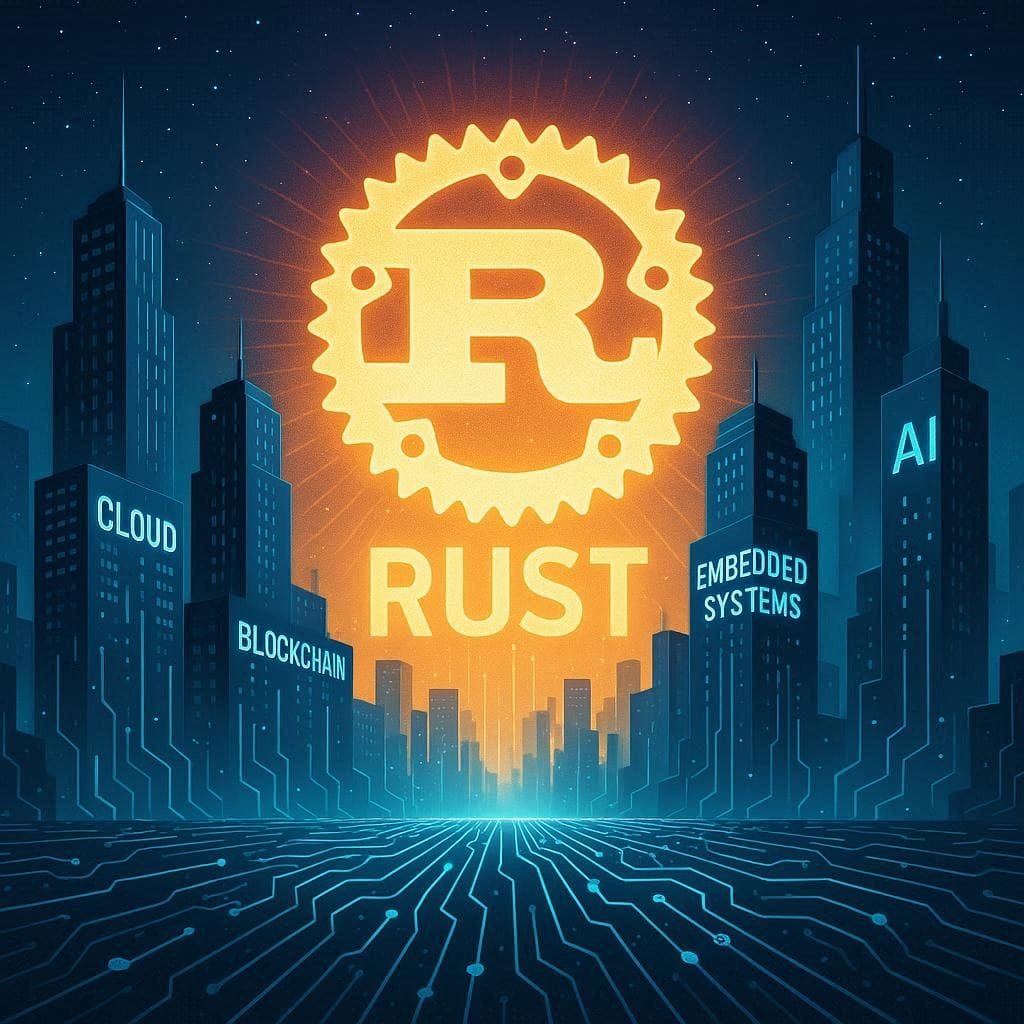
Looking ahead, Rust is positioned to dominate fields like embedded systems, blockchain development, game engines, and serverless computing. Its strong developer community and backing from large corporations ensure that it won’t fade away as just another “trendy” language. Instead, it’s shaping up to become the next generation C++—but safer, faster, and more reliable. For developers who want to future-proof their careers, learning Rust in 2025 is not just a good choice—it’s an essential one.
Conclusion — Key Takeaways for Developers in 2025
Rust’s momentum in 2025 isn’t a fad—it’s the natural outcome of a language that solves real problems developers face every day: memory safety without garbage collection, fearless concurrency, and performance that rivals C/C++. Across the stack, Rust now powers everything from high-throughput web services and serverless edge functions to embedded systems and blockchain runtimes. With WebAssembly bridging browser and server, Rust also gives web developers a credible path to ship performance-critical features without compromising on reliability. If you’ve followed this guide, the pattern is clear: Rust doesn’t aim to replace every language; it excels where safety, speed, and long-term maintainability are non-negotiable.
For teams, the value proposition is pragmatic: fewer security vulnerabilities, fewer production crashes, and code that often needs less firefighting later. For individual developers, Rust offers career durability—skills that transfer across backend, systems, and modern web stacks. The learning curve is real, but so are the dividends: once the ownership model “clicks,” you write with a confidence that’s hard to match elsewhere. A smart adoption path is incremental—start by rewriting a hot path or a performance-sensitive module (e.g., a data parser, an image/AI preprocessing step, or a high-traffic endpoint), then expand as the wins compound. (Internal link idea: reference your Web Performance Lies article to reinforce the “measure-first” mindset before optimizing.)
If you’re deciding what to do next, treat Rust as a strategic bet: pick one pilot project, set clear performance/safety goals, and benchmark before/after to quantify wins you can share with stakeholders. From there, lean on the ecosystem—tokio for async, axum or actix-web for APIs, wasm-bindgen for Wasm, and Rust’s excellent tooling (cargo, clippy, rustfmt) to keep quality high. As more companies standardize on Rust for core services, early adopters will be the ones writing the playbooks—and winning the trust to lead future platform choices. In short: if 2024 was the year Rust proved itself, 2025 is the year to put it to work.
Frequently Asked Questions
Q1. Is Rust worth learning in 2025 compared to C++ or Go?
Yes — Rust is increasingly adopted in system-level projects, blockchain, and web assembly. It balances performance with memory safety, making it a strong alternative to C++ and Go for many modern use cases.
Q2. Can Rust fully replace C++ in performance-critical applications?
Not fully — while Rust often matches or outperforms C++ in benchmarks, legacy systems, existing codebases, and certain specialized optimizations still keep C++ dominant in some industries.
Q3. How steep is Rust’s learning curve for new developers?
Rust is harder to learn than languages like Python or JavaScript due to strict ownership and borrowing rules. However, once mastered, it enforces best practices that reduce bugs and security issues.
Q4. Is Rust better for backend development or system programming?
Rust shines in system programming, but it’s also gaining traction in backend frameworks (like Actix and Axum). Developers now use Rust for APIs, microservices, and high-performance web servers.
Q5. Will Rust become mainstream in enterprise-level software?
Yes — companies like Microsoft, Amazon, and Google are actively adopting Rust. Its growth in cloud computing, embedded systems, and security-critical applications indicates it’s becoming mainstream.

🚀 Let's Build Something Amazing Together
Hi, I'm Abdul Rehman Khan, founder of Dev Tech Insights & Dark Tech Insights. I specialize in turning ideas into fast, scalable, and modern web solutions. From startups to enterprises, I've helped teams launch products that grow.
- ⚡ Frontend Development (HTML, CSS, JavaScript)
- 📱 MVP Development (from idea to launch)
- 📱 Mobile & Web Apps (React, Next.js, Node.js)
- 📊 Streamlit Dashboards & AI Tools
- 🔍 SEO & Web Performance Optimization
- 🛠️ Custom WordPress & Plugin Development